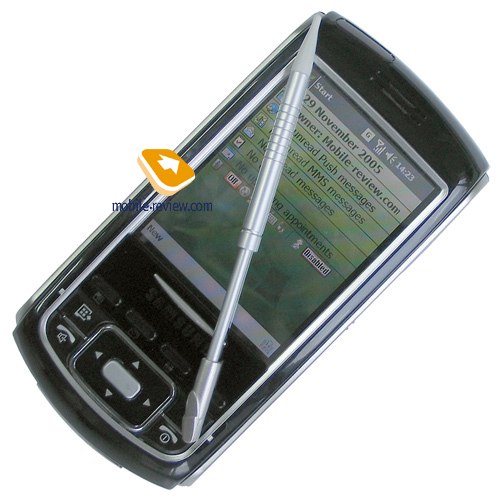
In the previous paragraph we mentioned two terms - smartphones and communicators. The distinction between them is too small, if there is any. I'm not to distinguish these two terms, but technically we define the communicator as the device with the open operating system (not in sense of source codes, but API), the QWERTY-keyboard or the touchscreen. The smartphone doesn't have it, except the open OS. I'd repeat the division is relative, and it will be no longer actual, as there will appear devices based on Windows Mobile and Nokia S60. Microsoft has officially announced that the next OS version Windows Mobile Photon won't be divided into Pocket PC and Smartphone, and Nokia confirmed that "in 2006 the S60 platform will get all functions of Nokia 7710", i.e. the support of touchscreens. But even after the final unification or merger there will be people to say that the X device is the smartphone and the Y device is the communicator and not otherwise. This reasoning won't be based on the logic, but on the own irrational idea on what's the communicator and the smartphone. For example, the following: "the communicator is the PDA with phone functions, and the smartphone is the phone with PDA functions". We won't start the term dispute again, a year ago we wrote about soon erasing of distinctions between communicators and smartphones and about the merger of various OS branches. The reaction then was ambiguous - the ones supported it, the others said this merger was impossible. Time has placed everything in order, but we've digressed from the main topic.
Currently the most prominent company producing Windows Mobile devices is the Taiwanese HTC. Other manufacturers appreciated the prospects of this direction and are preparing to expand to this market. Till the end of 2006 at least 15 (!) vendors will declare their intention to fight the place under the sun. Some of them already test strength with 1-2 trial models. One of the companies is the Korean Samsung. Let's see the way the company made to it, as we can't call the company a newbie on the market.
The first Samsung Pocket PC was the i700. When the early info was published in summer 2002, the model was interesting, and the public had been waiting for it with bated breath. However, by the moment of sales on the GSM market, it became morally out-of-date with its design and functionality. The steady low sales were due to the trademark and the lack of rival models in shops.
Then there appeared a CDMA slider Samsung i730 with the QWERTY-keyboard, a successful model at a due time on the market. I'd note that the CDMA-market got much more Samsung smartphones than the GSM market. The crucial moment took place at the CeBIT 2005 show, there was announced the model we review today, a GSM version of Samsung i730. The company's management swore that by the end of 2Q all announced models (Samsung i300, i750, D720, D730) would come out, as the company considered the segment commercially attractive. However the release had been delayed. During the data starvation period some media sources had cancelled Samsung i750. In fact, the model wasn't cancelled, but delayed till February 2006, a likely release date.
The delay of Samsung i750 makes the effect similar to other Samsung models. The models are very interesting during the announcement, they are discussed much, by the release the interest almost fades away. When the model becomes commercially available, it turns to be outdated, losing in functionality to its rivals. Should Samsung i750 be released in the beginning of 2005, it would have been a sales hit, but in the beginning of 2006 it is not that attractive, it would be easier to cancel it and offer something brand new. However, don't think the slider is bad, let's see together what it is and pass over to the review itself.
If we take into account the index of the model, so Samsung i750 follows the i700, but in fact they aren't alike, neither inside nor outside: smaller size, slider form, wireless adapters, other camera. The slider is based on the CDMA model Samsung i730, but here there are also distinctions: the digital keyboard instead of the QWERTY-keyboard, other screen, absent external antenna.
Due to shorter screen diagonal height and width are the minimal compared with other Pocket PC, but the device is somewhat thick, especially with the camera module (dimensions without prominent parts are 107.5x52.5x23.5 mm). This is one of the smallest communicators on the market. I'd mark the reaction of the users to the device. Those who know about communicators and deal with them found the device small and comfortable. This part of the audience (mainly men) estimated it positive. As for ladies, who used to ordinary handsets, they found the communicator big and unsuitable for them.
If we talk about personal impression, so the communicator turned to be smaller than it looks on the photos, you have to hold it in hands once to understand. The device turns to fit a man's hand. 155 g of weight is average for communicators. Taking into account recent trends on the market we may assume that the next Samsung communicator will be slimmer than its predecessors (16-17 mm). Dimensions of the model are slightly bigger than first Samsung sliders, later dimensions might get closer to Samsung D500/D600. Let's compare the 750i with other phones and smartphones.
When we compare it with Nokia N80, we see Samsung i750 is bigger, the difference isn't seen on the photos, but only when you hold it in hands.
Some dimensions of Sony Ericsson W900 are smaller or the same. The i750 is slightly wider, so it seems to be more massive than Sony Ericsson W900.
Qtek S110 (HTC Magician) is noticeably larger than the i750 in height and width, but it's thinner. If it wasn't for the thickness, we could call the model the smallest Pocket PC.
At last let's see it together with AnexTEK moboDA 3360 communicator by Wistron.
The shell color solution is the mixture of black and silver. The front panel is dominantly black, and the back panel is silver. The quality of materials applied is high, this is high quality expensive plastic. The assembly quality proves high, the model feels solid and expensive in hand, there is no hint at a backlash. Black plastic of the front panel is glossy and keeps fingerprints, however the dirtying are almost not noticeable. The rest parts are made of uneven plastic (side insertions, the keyboard), no fingerprints are left on them.
Top and bottom sides are beveled and rounded, except these details straight lines are dominating the design, we can call the model strict to some extent, there is no excessive angularity as well as excessive slick forms. In all, this is a business device for men. Now let's have a look at control elements.
At the top bevel we see an infrared port window, it is good to remotely control home appliances, there is a special built-in program for it, we'll talk about it in the Software part. Bluetooth and Wi-Fi LED is integrated into the infrared port. Here we also find a speaker for talks, its sound level is excessive.
The left side has a doubled sound volume control button. It features a tight feedback - you'll hardly press it accidentally. Near is a voice recorder button, the recording quality proved average, you can hear extraneous noise, you have to say something loud enough so to make out the sound file recorded within 2-3 meters distance. The voice recorder writes your voice as well as the voice of your talk mate, the file length depends on the memory available.
At the right side we see the following elements: the jack for a wire headset (only for Samsung headsets), the power/hold slider, the red camera button and the soft reset button. The bottom end has a microphone hole and a connector for USB synchronization and charging, like in Samsung i300. The back panel hides a camera lens, which is jutting out noticeably, a self-portrait mirror and a removable battery. At the angle we find a silo for the stylus pen. The stylus is telescopic with size lower than average, in all, it is comfortable. It rests in the silo tight, so you'll hardly lose it by accident.
The navigation button is comfortable with any applications, we haven't had problems with it. The action button is inside it. There is an extra speaker under it, which is averagely loud. Yes/No buttons are located by sides of the joystick, above them we see Menu and "C" buttons. And above there are 4 slim buttons to control the device without the stylus (more details on them read the Software part).
For the recent time we've got accustomed to the fact that the touchscreen size of Pocket PC communicators decreased from 3.5" to 2.8". 2.8" screens became an unofficial industry standard. On the one hand it allowed making smaller devices, on the other hand the screen surface got smaller and the info perception got lower as well. We can dispute for ages, what's the best, but the makers have already made their choice. However the 2.8" diagonal didn't turn out to be the shortest possible. For the sake of a smaller device the makers cut the diagonal to 2.4" like in case with our today's communicator (the same story is with GIGAYTE g-Smart).
Is such diagonal comfortable enough to work with the screen? To say the truth, I haven't noticed at once that the screen diagonal got shorter, there is no such striking difference as between 3.5" and 2.8". It is as comfortable to use the stylus with the touchscreen as with HTC Magician, for example. The number of dots remained the same - 320x240. As the size of the dot got smaller, the image looks slightly better. Other screen specs are typical for Pocket PC - a TFT matrix, 64K colors displayed, 5 backlight levels, good behavior under the sun, average viewing angles. If you do not plan to use the communicator much (organizer, checking e-mail from time to time, short Internet sessions), the small screen won't be a problem for you, but if you want to read much, surf web-pages for hours, watch full-length movies, so you'd better look for the communicator with a 2.8" diagonal or higher. However the final decision is yours, you'd better see the screen in a shop and decide whether it is good for you.
The back panel of the battery compartment is the battery at the same time. The capacity of this Li-Ion battery is the top secret. The capacity value isn't marked neither on the battery nor in the specs, we looked through the known codes, but failed to figure out the value. We suppose it makes up 1100 mAh. The sales package of Samsung i730 contains an extended capacity battery (1700 mAh) in addition to the standard battery, the pack of Samsung i750 is vague so far. The battery life tests offer inadequate results so far - they are much lower than they should be. Let's consider it the problem with immature software. We'll resume the topic with the battery life later (if the device won't be cancelled), when we get the pack with the commercial specimen, and now we won't make conclusions on the battery life.
http://www.mobile-review.com/review/samsung-i750-en.shtml
No comments:
Post a Comment