Actix Claims Top Spot in Automatic Wireless Optimisation Sector; Announces 51st Unique Carrier Customer for Radioplan Product Line...
Barcelona, 14th February 2007 – Actix, the recognised global leader for systems that enhance mobile network customer experience while reducing the total cost of ownership, today announced the 51st unique commercial carrier customer for Actix's Radioplan automatic optimisation products.
“This is a milestone that confirms the Actix Radioplan system as the dominant solution for automatic optimisation, and is a testament to the popularity, strength and reliability of the Radioplan product line,” said Henry McDonnell, Product Line Director. “Actix now supports more than 1,000 automatic optimisation users working for dozens of wireless operators worldwide, with an automatic optimisation customer base that includes 3 of the largest 4 wireless carriers in the United States and several of the worldwide top 10. The popularity of the Actix Radioplan solution re-confirms our decision to acquire Radioplan exactly one year ago, and we expect to continue to leverage Actix’s global presence to double the number of users worldwide in the coming year.”
Actix Radioplan solutions are designed to automatically optimise the total cost of ownership of a wireless network, while rapidly and accurately improving the quality of experience offered to the end customer. The Radioplan solution includes a wide range of automatic optimisation functions designed to enable a more efficient initial deployment and live network optimisation process.
The results of projects carried out by Actix on behalf of major wireless customers have led to impressive results, with savings of billions of dollars being directly attributable to the use of Actix automatic optimisation solutions.
http://www.itbcellular.com/pr/12602
Friday, February 16, 2007

Aricent Powers Broadband Wireles Home 3G Femtocell Access Point
The Oyster 3G is one of the first in a new category of femtocell products that has captured the imagination of the communications service provider community. Oyster 3G is an in-building access solution that increases both network coverage and user satisfaction - while simultaneously reducing a variety of costs to operators. ip.access' 3G Converge architecture allows communications service providers to seamlessly upgrade their infrastructure to provide triple and quadruple play services without disturbing existing networks.
The partnership between Aricent and ip.access began at the start of the product development process. Over a nine month period, Aricent worked with ip.access to design, develop and integrate Aricent software into the 3G access controller, bringing together hardware and software components to accelerate the delivery and match the evolving project requirements. The highly collaborative program resulted in the delivery of the Aricent software that powers Oyster 3G system.
"In the battle for the building, operators are applying a wide range of hyperconnected systems to drive in-building connectivity and increase subscriber usage," said Ajay Gupta, vice president of the wireless and convergence business unit at Aricent. "In stitching together this all-IP network of hyperconnected nodes, it's important that the software that powers it is developed with a deep understanding of not only the 3G core and access networks, but also of the experience that end-users will expect. Aricent's development partnership with ip.access establishes a benchmark for how to deliver innovative new products while slashing time-to-market. All-IP systems such as Oyster 3G will completely change the way end users, service providers and the industry at large think of in-building connectivity and we're excited to have been a partner in the development of ip.access femtocell access point system."
"ip.access is pleased with the results of our partnership with Aricent," said Nick Johnson CTO of ip.access. "We selected Aricent as our software development partner for the ambitious Oyster 3G(TM) development program because of Aricent's deep domain expertise in communications software and its proven track record in delivering software for leading edge solutions. Being short-listed for the Best Radio Access Product category of the prestigious GSM Awards is testament to the quality of the product that has come out of the partnership."
3G for All? … Motorola not enticed by GSMA's latest low-cost-device initiative
The GSM Association could be struggling to gain the support of tier 1 handset vendors for its 3G for all program, following the decision of Motorola not to take part. The U.S. vendor should have been a major supporter of the latest program, having won both tenders in the GSMA's Emerging Mobile Handsets initiative in 2005.
"Motorola's strong support for the EMH initiative means its decision not to take part in 3G for All is a major blow to the GSMA's ambitions for the project" comments Michael Carroll, editor of Mobile Handset Analyst.
MHA estimates the U.S. vendor could have generated profits up to US$32 million through sales of its EMH handsets, but the high cost of producing a 3G terminal means there is little benefit for tier 1 vendors to produce a similar low-cost terminal for 3G networks. Margins on low-cost 3G terminals will remain low until 2008, when the cost of production will fall from US$150 at present, to US$55. However, the GSMA has not set a target price point that the device which wins the most votes must meet, meaning it is hard to see what level of profit vendors could achieve. An additional burden could come in the form of the high cost of 3G IP. "The majority of tier 1 vendors can negotiate favourable license rates by using their own IP as a bargaining chip, but lower-tier vendors may struggle because they don't have IP to bring to the table," Carroll says.
Many industry insiders believe the market for 3G still needs to be proven before attention is given to low-cost 3G devices. Brett Simpson, a director at Arete Research, says. "The 2G-lowcost effort was about making mobile voice more affordable in emerging markets. For 3G, I am still struggling to find proof points around where 3G is adding value to consumers."
The winning handset is due to be unveiled at the 3GSM World Congress in February.
Source: Informa.
"Motorola's strong support for the EMH initiative means its decision not to take part in 3G for All is a major blow to the GSMA's ambitions for the project" comments Michael Carroll, editor of Mobile Handset Analyst.
MHA estimates the U.S. vendor could have generated profits up to US$32 million through sales of its EMH handsets, but the high cost of producing a 3G terminal means there is little benefit for tier 1 vendors to produce a similar low-cost terminal for 3G networks. Margins on low-cost 3G terminals will remain low until 2008, when the cost of production will fall from US$150 at present, to US$55. However, the GSMA has not set a target price point that the device which wins the most votes must meet, meaning it is hard to see what level of profit vendors could achieve. An additional burden could come in the form of the high cost of 3G IP. "The majority of tier 1 vendors can negotiate favourable license rates by using their own IP as a bargaining chip, but lower-tier vendors may struggle because they don't have IP to bring to the table," Carroll says.
Many industry insiders believe the market for 3G still needs to be proven before attention is given to low-cost 3G devices. Brett Simpson, a director at Arete Research, says. "The 2G-lowcost effort was about making mobile voice more affordable in emerging markets. For 3G, I am still struggling to find proof points around where 3G is adding value to consumers."
The winning handset is due to be unveiled at the 3GSM World Congress in February.
Source: Informa.
LG LG VX6000
The new generation of color screens. LG released the VX6000 to become the flagship model for Verizon Wireless. The clamshell design has both internal and external displays for easy viewing. An internal 262k TFT color screen, and an external rolling OEL screen.
Other features include CMX-MIDI polyphonic ring tones, and a built-in 640 x 480 pixel CMOS camera, voice activated dialing, and Get It Now service. The VX6000 is released to compete in the high end cellular phone market.
Perhaps the biggest drawback with the VX6000 is beyond its control. LG designed this phone specifically for Verizon's CDMA network, incompatible with all other networks. But if you're a loyal Verizon subscriber, the you will want to read this review.
If you haven't committed to a service plan yet, then you might want to see what Verizon newest phone has to offer. So read on and see all the pros and cons from our review. This just may be the phone you've been looking for.The LG VX6000 is Verizon Wireless's flagship model. Unlike GSM phones, the VX6000 was specifically design to work with Verizon's CDMA network. This phone is incompatible with other CDMA networks.
CDMA varies with GSM and TDMA fundamentally based on how voice is transmitted through the airwaves. The inherent technical properties of CDMA makes voice quality more resistant to interference and noise. That results in cleaner and clearer voices.
The VX6000 voice quality is much better than GSM phones. It has to do more with the technology and service rather than to phone itself. But regardless, superior nonetheless.
So if CDMA is the better technology why didn't it take off? Well, simply put, because the rest of the world already had already settled on a standard. GSM's appeal was its ability to store customer information on a SIM card. So swapping phones was effortless. With Europe and Asia firmly embracing GSM, CDMA came too late and was always the minority. So the VX6000 is not compatible when outside the Verizon network. To many this may not be what they are looking for. If a world phone is needed, then GSM is the way to go.
From a hardware perspective, the VX6000 is stunning. With color internal and external screens, the VX6000 is sure to be a hit. As for ring tones, the phone is CMX 3.0 compliant. Midi files can to be converted to 16 bit mono wav and used for ring tones. As opposed to midis which is like storing a sheet music of notes to play. By using wav files, VX6000 has the ability to not only play music, but use voices, or real music from CDs.
 Additionally, with the popularity of built-in cameras on cellular phones, the VX6000 does not disappoint. In a market filled with camera phones, the VX6000 is the first one to be released on the Verizon network. A built-in 640 x 480 pixel, 330k pixel resolution, CMOS camera is attached to the back. The camera as a whole performed well, but where it really shines is the versatility of the functions. In addition to a 4X digital zoom, the phone also comes with a wide variety of image adjusting filters and tools. And for the playful side, custom frames to add to your photos are available too.
So with all the great features what's not to like about the VX6000? Well... for one, the difficulty in sending content to your phone. Verizon has made it very difficult to transfer files from a PC to the VX6000. Coincidentally, it is extremely easy to use the built in BREW platform to download Verizon's online content... at a fee. Undoubtedly, people that buy this phone want to take advantage of all the colors and multimedia features. And if you want to customize it, it's going to take a couple bucks.
Another thing to consider is that the VX6000 does NOT have analog. It only runs on digital CDMA 800 / 1900 bands. So if you do frequent traveling to rural areas and use analog, then this will be a big setback.
http://www.mobiledia.com/reviews/lg/vx6000/page1.htmlReview GSM communicator Samsung SGH-i750
Sales volumes of smartphones and communicators are growing by hundreds percent, news blocks are full of announcements of new models. The market growth rate won't be slower in near future, but even higher. The main struggle will be between operating systems based on Windows CE and Symbian kernels. Palm OS is living out its days, and Linux solutions are prospective directions (including Linux version of the next Palm OS), but only on paper, we don't see a global expansion outside the Asian region. 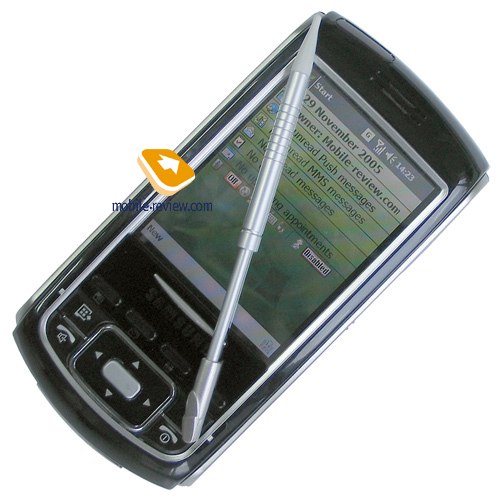
In the previous paragraph we mentioned two terms - smartphones and communicators. The distinction between them is too small, if there is any. I'm not to distinguish these two terms, but technically we define the communicator as the device with the open operating system (not in sense of source codes, but API), the QWERTY-keyboard or the touchscreen. The smartphone doesn't have it, except the open OS. I'd repeat the division is relative, and it will be no longer actual, as there will appear devices based on Windows Mobile and Nokia S60. Microsoft has officially announced that the next OS version Windows Mobile Photon won't be divided into Pocket PC and Smartphone, and Nokia confirmed that "in 2006 the S60 platform will get all functions of Nokia 7710", i.e. the support of touchscreens. But even after the final unification or merger there will be people to say that the X device is the smartphone and the Y device is the communicator and not otherwise. This reasoning won't be based on the logic, but on the own irrational idea on what's the communicator and the smartphone. For example, the following: "the communicator is the PDA with phone functions, and the smartphone is the phone with PDA functions". We won't start the term dispute again, a year ago we wrote about soon erasing of distinctions between communicators and smartphones and about the merger of various OS branches. The reaction then was ambiguous - the ones supported it, the others said this merger was impossible. Time has placed everything in order, but we've digressed from the main topic.
Currently the most prominent company producing Windows Mobile devices is the Taiwanese HTC. Other manufacturers appreciated the prospects of this direction and are preparing to expand to this market. Till the end of 2006 at least 15 (!) vendors will declare their intention to fight the place under the sun. Some of them already test strength with 1-2 trial models. One of the companies is the Korean Samsung. Let's see the way the company made to it, as we can't call the company a newbie on the market.
The first Samsung Pocket PC was the i700. When the early info was published in summer 2002, the model was interesting, and the public had been waiting for it with bated breath. However, by the moment of sales on the GSM market, it became morally out-of-date with its design and functionality. The steady low sales were due to the trademark and the lack of rival models in shops.
Then there appeared a CDMA slider Samsung i730 with the QWERTY-keyboard, a successful model at a due time on the market. I'd note that the CDMA-market got much more Samsung smartphones than the GSM market. The crucial moment took place at the CeBIT 2005 show, there was announced the model we review today, a GSM version of Samsung i730. The company's management swore that by the end of 2Q all announced models (Samsung i300, i750, D720, D730) would come out, as the company considered the segment commercially attractive. However the release had been delayed. During the data starvation period some media sources had cancelled Samsung i750. In fact, the model wasn't cancelled, but delayed till February 2006, a likely release date.
The delay of Samsung i750 makes the effect similar to other Samsung models. The models are very interesting during the announcement, they are discussed much, by the release the interest almost fades away. When the model becomes commercially available, it turns to be outdated, losing in functionality to its rivals. Should Samsung i750 be released in the beginning of 2005, it would have been a sales hit, but in the beginning of 2006 it is not that attractive, it would be easier to cancel it and offer something brand new. However, don't think the slider is bad, let's see together what it is and pass over to the review itself.
If we take into account the index of the model, so Samsung i750 follows the i700, but in fact they aren't alike, neither inside nor outside: smaller size, slider form, wireless adapters, other camera. The slider is based on the CDMA model Samsung i730, but here there are also distinctions: the digital keyboard instead of the QWERTY-keyboard, other screen, absent external antenna.
Due to shorter screen diagonal height and width are the minimal compared with other Pocket PC, but the device is somewhat thick, especially with the camera module (dimensions without prominent parts are 107.5x52.5x23.5 mm). This is one of the smallest communicators on the market. I'd mark the reaction of the users to the device. Those who know about communicators and deal with them found the device small and comfortable. This part of the audience (mainly men) estimated it positive. As for ladies, who used to ordinary handsets, they found the communicator big and unsuitable for them.
If we talk about personal impression, so the communicator turned to be smaller than it looks on the photos, you have to hold it in hands once to understand. The device turns to fit a man's hand. 155 g of weight is average for communicators. Taking into account recent trends on the market we may assume that the next Samsung communicator will be slimmer than its predecessors (16-17 mm). Dimensions of the model are slightly bigger than first Samsung sliders, later dimensions might get closer to Samsung D500/D600. Let's compare the 750i with other phones and smartphones.
When we compare it with Nokia N80, we see Samsung i750 is bigger, the difference isn't seen on the photos, but only when you hold it in hands.
Some dimensions of Sony Ericsson W900 are smaller or the same. The i750 is slightly wider, so it seems to be more massive than Sony Ericsson W900.
Qtek S110 (HTC Magician) is noticeably larger than the i750 in height and width, but it's thinner. If it wasn't for the thickness, we could call the model the smallest Pocket PC.
At last let's see it together with AnexTEK moboDA 3360 communicator by Wistron.
The shell color solution is the mixture of black and silver. The front panel is dominantly black, and the back panel is silver. The quality of materials applied is high, this is high quality expensive plastic. The assembly quality proves high, the model feels solid and expensive in hand, there is no hint at a backlash. Black plastic of the front panel is glossy and keeps fingerprints, however the dirtying are almost not noticeable. The rest parts are made of uneven plastic (side insertions, the keyboard), no fingerprints are left on them.
Top and bottom sides are beveled and rounded, except these details straight lines are dominating the design, we can call the model strict to some extent, there is no excessive angularity as well as excessive slick forms. In all, this is a business device for men. Now let's have a look at control elements.
At the top bevel we see an infrared port window, it is good to remotely control home appliances, there is a special built-in program for it, we'll talk about it in the Software part. Bluetooth and Wi-Fi LED is integrated into the infrared port. Here we also find a speaker for talks, its sound level is excessive.
The left side has a doubled sound volume control button. It features a tight feedback - you'll hardly press it accidentally. Near is a voice recorder button, the recording quality proved average, you can hear extraneous noise, you have to say something loud enough so to make out the sound file recorded within 2-3 meters distance. The voice recorder writes your voice as well as the voice of your talk mate, the file length depends on the memory available.
At the right side we see the following elements: the jack for a wire headset (only for Samsung headsets), the power/hold slider, the red camera button and the soft reset button. The bottom end has a microphone hole and a connector for USB synchronization and charging, like in Samsung i300. The back panel hides a camera lens, which is jutting out noticeably, a self-portrait mirror and a removable battery. At the angle we find a silo for the stylus pen. The stylus is telescopic with size lower than average, in all, it is comfortable. It rests in the silo tight, so you'll hardly lose it by accident.
The navigation button is comfortable with any applications, we haven't had problems with it. The action button is inside it. There is an extra speaker under it, which is averagely loud. Yes/No buttons are located by sides of the joystick, above them we see Menu and "C" buttons. And above there are 4 slim buttons to control the device without the stylus (more details on them read the Software part).
For the recent time we've got accustomed to the fact that the touchscreen size of Pocket PC communicators decreased from 3.5" to 2.8". 2.8" screens became an unofficial industry standard. On the one hand it allowed making smaller devices, on the other hand the screen surface got smaller and the info perception got lower as well. We can dispute for ages, what's the best, but the makers have already made their choice. However the 2.8" diagonal didn't turn out to be the shortest possible. For the sake of a smaller device the makers cut the diagonal to 2.4" like in case with our today's communicator (the same story is with GIGAYTE g-Smart).
Is such diagonal comfortable enough to work with the screen? To say the truth, I haven't noticed at once that the screen diagonal got shorter, there is no such striking difference as between 3.5" and 2.8". It is as comfortable to use the stylus with the touchscreen as with HTC Magician, for example. The number of dots remained the same - 320x240. As the size of the dot got smaller, the image looks slightly better. Other screen specs are typical for Pocket PC - a TFT matrix, 64K colors displayed, 5 backlight levels, good behavior under the sun, average viewing angles. If you do not plan to use the communicator much (organizer, checking e-mail from time to time, short Internet sessions), the small screen won't be a problem for you, but if you want to read much, surf web-pages for hours, watch full-length movies, so you'd better look for the communicator with a 2.8" diagonal or higher. However the final decision is yours, you'd better see the screen in a shop and decide whether it is good for you.
The back panel of the battery compartment is the battery at the same time. The capacity of this Li-Ion battery is the top secret. The capacity value isn't marked neither on the battery nor in the specs, we looked through the known codes, but failed to figure out the value. We suppose it makes up 1100 mAh. The sales package of Samsung i730 contains an extended capacity battery (1700 mAh) in addition to the standard battery, the pack of Samsung i750 is vague so far. The battery life tests offer inadequate results so far - they are much lower than they should be. Let's consider it the problem with immature software. We'll resume the topic with the battery life later (if the device won't be cancelled), when we get the pack with the commercial specimen, and now we won't make conclusions on the battery life.
http://www.mobile-review.com/review/samsung-i750-en.shtmlSamsung IP-830w – Sprint’s CDMA/GSM World Smartphone
By Troy Dreier
December 7, 2006
The IP-830w measures 4.5 x 2.3 x 1.0 inches and weighs 6.4 ounces, which puts it on the heavy side (the Treo is 6.0 ounces). It's a solid, chunky smartphone that offers both CDMA and GSM service (CDMA 800/1900; GSM 900/1800), although you can only use GSM when you're traveling abroad.
There's a SIM card and two foreign outlet adapters, so that globetrotters are ready to go. It also comes with a spare stylus, a spare battery, stereo headphones, and a USB connection cable.
The phone offers a decent sized display (240 x 320 pixels; 262,000 colors), Windows Mobile 5.0 with AKU (Adaptation Kit Update) 2.6, Bluetooth 1.1 (supporting headsets, dial-up networking, file transfers, and input devices), EV-DO high-speed e-mail and Internet, voice recorder, and speakerphone. You'll get 128 MB of storage. Missing are Wi-Fi and a camera.
Start Screen
Interface
At first glance, the IP-830w looks like several other chunky Windows smartphones. Its stylish blue-black trim gives it an edge, while its heft and use of an external antenna, which needs to be extended for good reception, holds it back.
The controls will be instantly familiar to smartphone veterans: The front holds a directional pad, two softkeys, two dedicated application keys (for opening Outlook of the application launcher), as well phone call start, phone call end, and back buttons.
The left side is packed with the headphone port (covered by an especially tricky flap), the record button (you can take voice notes or record phone calls, although only your end of the conversation will be recorded), volume controls, and an on/off/hold switch. The left side holds only the SDIO expansion slot (the phone doesn't come with a card).
Slide the front upward to reveal the tiny thumb-operated QWERTY keyboard. The number keys are a different color, which speeds up dialing.
Software
The IP-830w comes loaded with the usual Windows Mobile bundle, including Excel Mobile, Word Mobile, Pocket MSN, and Windows Media Player 10 Mobile.
The attractively glossy World Clock shown in most of the promotional pictures disappointed us, since it only has 38 cities preloaded. You can load others yourself, but that involves knowing their time zones.
World Clock
Travelers will also like the Global Adviser program, which informs you of local customs, tipping practices, and business hours for a long list of countries. It's fun to read, whether or not you're traveling. Remote Control software makes it easy to turn your handheld into a remote for your entertainment center.
Use IP-830 As Global Adviser
The smartphone also comes with GoodLink software, for setting up push e-mail, allowing you to get your messages in real-time.
Performance
The IP-830w is least successful as a basic phone. Dialing with either the onscreen number pad or the physical buttons is awkward, a problem shared with similar smartphones.
Its onscreen buttons lack any tactile sensation, while the physical buttons are too small to press easily. Plus, the phone is top-heavy when slid open, so using it one-handed is difficult. Holding its broad flat screen against your cheek while talking feels odd, and the onscreen controls don't lock while you're in a call, so you can tap things by accident.
Use IP-830 As Remote
The phone is rated for 3.4 hours of talk time and 5.4 days of standby, which is much lower than some competitors. We found call quality poor in the New York City area, with calls often echo-y and difficult to hear.
Subscribe to:
Posts (Atom)